
SaaS Cancellation Flows: How to Save Customers Without Resorting to Dark Patterns
The cancellation flow is the last conversation you have with a leaving customer, and most SaaS products waste it. Here is how to design a cancellation experience that recovers revenue, collects honest feedback, and leaves the door open for a return.
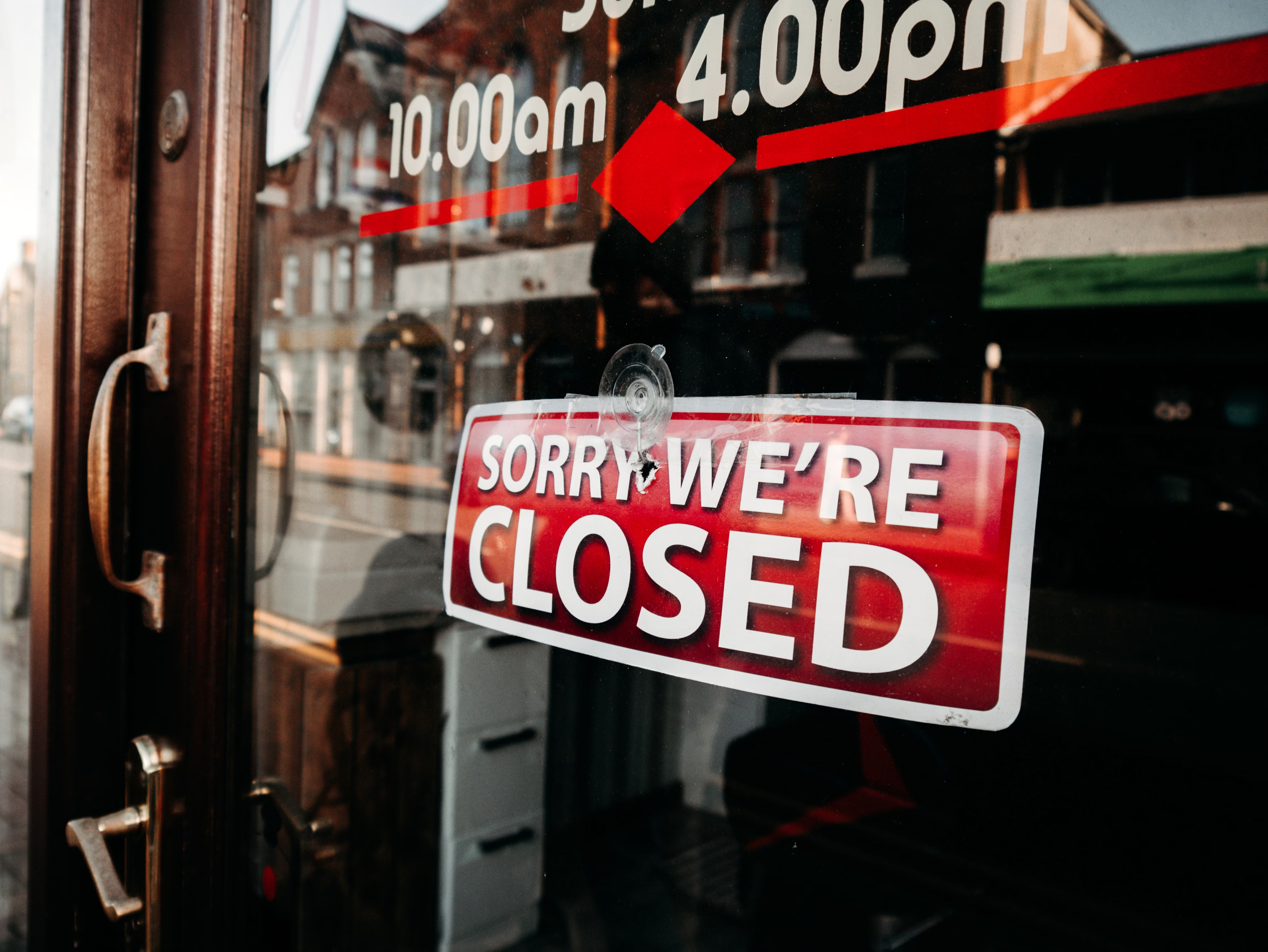
Every SaaS product has a cancellation flow, whether or not anyone designed it. In many indie products it is a single "Cancel subscription" button buried in billing settings that ends the relationship instantly and silently. In others it is a maze of confirmation screens, guilt-tripping copy, and phone-only cancellation designed to make leaving so painful that customers give up.
Both approaches waste one of the most valuable moments in the customer lifecycle. A customer who has decided to cancel is telling you something important, and a well-designed flow can recover a meaningful share of them, capture the reason they are leaving, and keep a positive relationship with the ones who go anyway. The goal is not to trap anyone. It is to make sure a customer who would have stayed with the right offer actually sees that offer.
Why Dark Patterns Backfire
The temptation to make cancellation difficult is understandable. Every cancelled subscription is lost recurring revenue, and friction does reduce cancellation rates in the short term.
But the costs show up elsewhere. Customers who feel trapped dispute charges with their bank, which creates chargeback fees and can put your payment processor account at risk. They leave angry reviews and warn others away in communities where your next customers spend time. And regulators in several jurisdictions have moved against subscription traps, with rules requiring that cancelling be roughly as easy as signing up.
There is also a simpler argument: a customer who stays only because leaving is hard is not a retained customer. They are a future churn event with added resentment. The revenue you hold onto through friction is low-quality revenue, and it rarely lasts more than another billing cycle or two.
The Anatomy of a Good Cancellation Flow
An effective, honest cancellation flow usually has three or four steps and can be completed in under a minute:
- A short reason survey. One question, multiple choice, with an optional free-text field.
- A targeted response. An offer or resource matched to the reason the customer selected.
- A clear confirmation. What happens to their data, when access ends, and how to come back.
- A follow-up. A brief email confirming the cancellation and, later, a well-timed win-back message.
The key design principle is that the cancel action is always visible. The customer should never wonder how to finish leaving. Offers appear alongside a clearly labeled "Continue cancelling" option, not instead of it.
Asking Why They Are Leaving
The reason survey is the engine of the whole flow. Keep it to one question with five to seven options that map to distinct problems you can actually respond to. A typical set includes:
- It is too expensive.
- I am not using it enough.
- It is missing a feature I need.
- I found a better alternative.
- It was a temporary project.
- Technical issues or bugs.
- Other (with a text field).
Each option should map to a specific response in the next step. If an option has no corresponding response, it is still worth collecting for product insight, but think carefully about whether it deserves its own category.
Make the survey required but fast. A single click is a small ask, and the data it produces — aggregated across every cancellation — is one of the clearest signals you will ever get about why your product loses customers.
Matching the Offer to the Reason
This is where most of the recovered revenue comes from. A generic "Are you sure? Here's 20% off!" shown to everyone is weak because it ignores what the customer just told you. A targeted response feels like listening.
Too expensive: Offer a temporary discount, a downgrade to a cheaper plan, or a switch to annual billing at a lower effective monthly rate. Price-sensitive customers often stay for a meaningful discount.
Not using it enough: Offer to pause the subscription for one to three months instead of cancelling. Pausing is one of the most effective retention tools available because it addresses the real problem — the customer does not need the product right now — without forcing a permanent decision.
Missing a feature: Show whether the feature is on the roadmap, link to a workaround, or offer a quick call. Sometimes the feature already exists and the customer simply never found it.
Found an alternative: Ask which one, and accept the answer gracefully. This is competitive intelligence, not a moment to argue.
Temporary project: Confirm the cancellation smoothly and make returning easy. These customers are likely to come back when the next project starts if the exit was pleasant.
Technical issues: Route to support immediately with priority handling. A bug that drove someone to cancel is a bug that is quietly driving others away too.
The Power of the Pause Option
Pausing deserves special attention because it often outperforms discounts. Many SaaS customers cancel not because the product failed them, but because their need is seasonal or temporarily on hold — a freelancer between clients, an agency between campaigns, a founder taking a break.
For these customers, a discount does not help; they do not need the product at any price this month. A pause lets them keep their data, settings, and history while billing stops. When the pause ends, billing resumes automatically, and a reminder email a few days before gives them a chance to extend or cancel properly.
Most billing platforms now support pausing natively or through a simple workaround. If yours does not, it is worth building. A paused customer who resumes is far cheaper than a new customer acquired from scratch.
Writing the Confirmation Screen
Once a customer chooses to cancel, the confirmation screen should be calm and specific. Tell them exactly when their access ends — usually the end of the current billing period — and what happens to their data. If data is retained for a period before deletion, say how long. If they can export it, link to the export.
Avoid guilt-based copy. Lines like "We're sad to see you go" are fine in moderation; lines that list everything the customer will lose in alarming red text are not. The tone you strike here is the last impression the customer has of your product, and it shapes whether they come back or recommend you to someone else.
Include a single sentence about how to return, such as noting that their account and settings will be waiting if they reactivate within a certain period. Reducing the cost of coming back increases the likelihood that they do.
Win-Back After Cancellation
The relationship does not end at the confirmation screen. A short, well-timed win-back sequence can recover a surprising number of cancelled customers.
The first email, sent immediately, simply confirms the cancellation and restates the key details. The second, sent somewhere between 30 and 60 days later, is where the win-back happens — ideally tied to something real, such as a feature that addresses the reason they gave for leaving, or a meaningful improvement shipped since they left. "You told us you needed X. We built it." is one of the most persuasive emails a SaaS product can send.
Keep the sequence short. One or two follow-ups is respectful; a long drip campaign aimed at someone who chose to leave is not.
Measuring What the Flow Is Doing
Track three numbers: the save rate (the percentage of customers who start the flow and do not cancel), the distribution of cancellation reasons, and the reactivation rate of customers who cancelled in previous months.
The save rate tells you whether your offers are working. The reason distribution tells you where your product is failing. The reactivation rate tells you whether your exit experience is leaving the door open. Review all three monthly. A cancellation flow designed this way is not a trap — it is a feedback system and a retention tool, and it treats customers in a way that makes them more likely to return.